
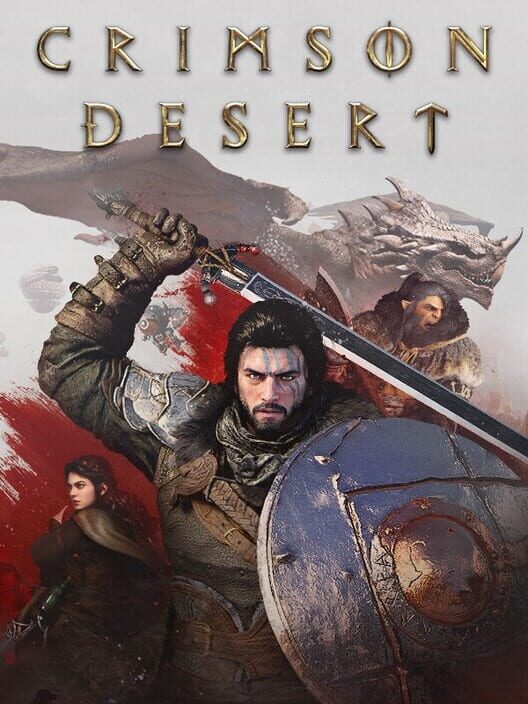
Crimson Desert
- Released
- 20 March 2026Sold now as Crimson Desert Enhanced
- Platforms
- PS5, Xbox Series X|S, PC
- Developer
- Pearl Abyss
- Publisher
- Pearl Abyss
Player ratings read 28 September 2026
The short version. Run balanced mode. If your TV does 120Hz, turn the 120Hz option on, because Pearl Abyss warns that V-Sync in balanced mode can lock you to 30fps whenever the frame rate wobbles between 30 and 40. My full settings are below, screenshotted on version 1.15.00 and unchanged by 1.16.00 or 1.16.01, neither of which added a display option on PS5 Pro. Then read on for whether the game is for you at all, which is the harder question.
There is a kind of game I have learned to distrust. It moves you forward through a corridor of cutscenes, and somewhere behind you a door closes on a room you did not finish looking at. The Last of Us does this beautifully and I still resent it. If I miss something, I want to be able to go back and get it.
Crimson Desert never does that. In 193 hours on a PS5 Pro I did not once hit a wall that said the moment had passed. That is why it is on the shelf, and it is a stranger reason than it sounds, because almost nobody reviews games on this axis. Reviewers ask whether a world is big. The more useful question is whether it stays open.
Pearl Abyss released it on 19 March 2026 after a development cycle long enough to become a running joke. Two million copies went in the opening weekend, five million worldwide by mid-April, and a Steam concurrent peak of 276,261. The audience question is settled. What is worth talking about is the shape of the thing.
What it feels like
The world carries itself the way Red Dead Redemption 2’s does, dense and unhurried and full of things that are not waiting for you to arrive. The combat is closer to Black Myth: Wukong, which is a high compliment and one I do not hand out lightly. You can fight with weapons or with your fists, and each route branches into its own skill tree, so experimentation is rewarded rather than punished. There is no single correct build funnelling you into one approach. I kept finding second answers to fights I thought I had solved.
You also get three playable characters, Kliff, Oongka and Damiane, and you can switch between them or bring them along to help on raids. That is more than a roster gimmick. Swapping character changes which problems are easy, so a wall you bounced off as one becomes a side door as another. Pearl Abyss has kept building on it too: patch 1.13.00 in July finally let Oongka and Damiane into the Abyss, which had been Kliff’s private club until then.
Crafting, trading and NPC interaction are all real systems rather than menu dressing. But the part that made 193 hours possible is that I kept stumbling into things. An encounter here, a puzzle there, an opportunity I had no idea existed and no quest marker pointing at it. The world reacts to what you decide. It does not queue up your next obligation and wait.
How it runs on PS5 Pro, and how that changed
Update, 2 August 2026. Two patches have landed since this was written. 1.16.00 on 1 August is a trading overhaul, and its only platform-wide rendering changes are reduced flickering around window frames and similar edges, plus a fix for distant objects not drawing in some areas. Its AMD FSR and Ray Regeneration work is tagged PC only. 1.16.01 on 2 August is a single-line hotfix for camp storage menus opening as the wagon cargo screen. Neither patch touches VRR, frame pacing, or the display modes described below.
I am not qualified to measure frame times, so the measurement belongs to Digital Foundry. What I can do is tell you what happened afterwards, because the version John Linneman tested is not the version you would buy today.
The headline is the engine. Crimson Desert runs on Pearl Abyss’s proprietary BlackSpace Engine rather than Unreal 5, and Linneman’s assessment of near-final Pro code on 12 March was that it delivers an open world unlike any other on the strength of its near-field detail and scale. Ray-traced diffuse global illumination is the centrepiece and it survives the console port intact, so sunlight bounces indoors and your lantern throws real-time shadows. Displacement mapping is used at a scale he said he had never seen before.
Three modes on the Pro. Performance targets 60fps from a 1080p base, balanced 40fps from 1440p, quality 30fps at native 4K. Ray tracing is on in all three, though reflections are pared back in the two faster modes and only quality gets the better distant reflections. Linneman found 30fps and 40fps stable while 60fps proved harder depending on how many entities were on screen, which he put down to a CPU limit, and he was clear it never crossed into feeling poorly optimised. His preference was balanced mode. After 193 hours, so is mine.
He raised two problems with that pre-release build. It shipped with first-generation PSSR rather than the upgraded version, and it had no low frame-rate compensation, so dropping out of the VRR window produced visible screen tearing.
The first was fixed across three patches. Version 1.02.00 on 4 April applied the Upgraded PSSR Sharpen feature on PS5 Pro and Upgraded PSSR Native AA to quality mode specifically. Version 1.03.00 then handed the control to you: “[PlayStation 5 Pro] Added the ‘PSSR Sharpness’ option under Settings > Video.” And 1.04.02 fixed unstable screen brightness when that option was switched on, which is the sort of sequence that tells you a feature shipped in a hurry and got tidied up afterwards. Those are first-party patch notes, not inference.
The second was acknowledged but not solved. On 24 March, five days after launch, Pearl Abyss quietly added two lines to the 1.00.03 notes. The first separated 120Hz output into an optional setting and dropped the default to 60Hz. The second is the one worth knowing: “In Balanced Mode, enabling V-Sync may cause the frame rate to lock at 30 FPS when it fluctuates between 30 and 40 FPS. For smoother gameplay above 40 FPS, we recommend enabling the 120Hz option if your display supports it, or turning off V-Sync in a VRR-supported environment.”
That is a developer telling you how to route around a limitation, not announcing they removed one. And it is the last word on the subject.
We have now read every patch note Pearl Abyss has published, from 1.00.03 on 23 March through 1.16.01 on 2 August, searching each one for VRR, low frame-rate compensation, tearing and frame pacing. Not one of them mentions any of it again. Thirty-two patch notes in four and a half months, including substantial PSSR work and a whole Abyss expansion for two extra characters, and nothing. That is notes rather than versions: Pearl Abyss sometimes publishes a version per platform rather than all at once, so 1.00.04 went out twice, once as a PlayStation hotfix and once as a Mac Steam hotfix.
So the honest position: the only first-party statement on this is the workaround dated 24 March 2026. No patch has claimed a fix. A silent fix is always possible and documents cannot rule one out, which is why this sits on the ledger as Unverified rather than Confirmed, and why the only thing that would close it is somebody dropping below the VRR window on a Pro and watching for tearing. But if you are wondering whether you missed an announcement, you did not. There was not one.
My settings, on version 1.15.00
Rather than describe the menu, here is exactly what I run. Others, then Video.
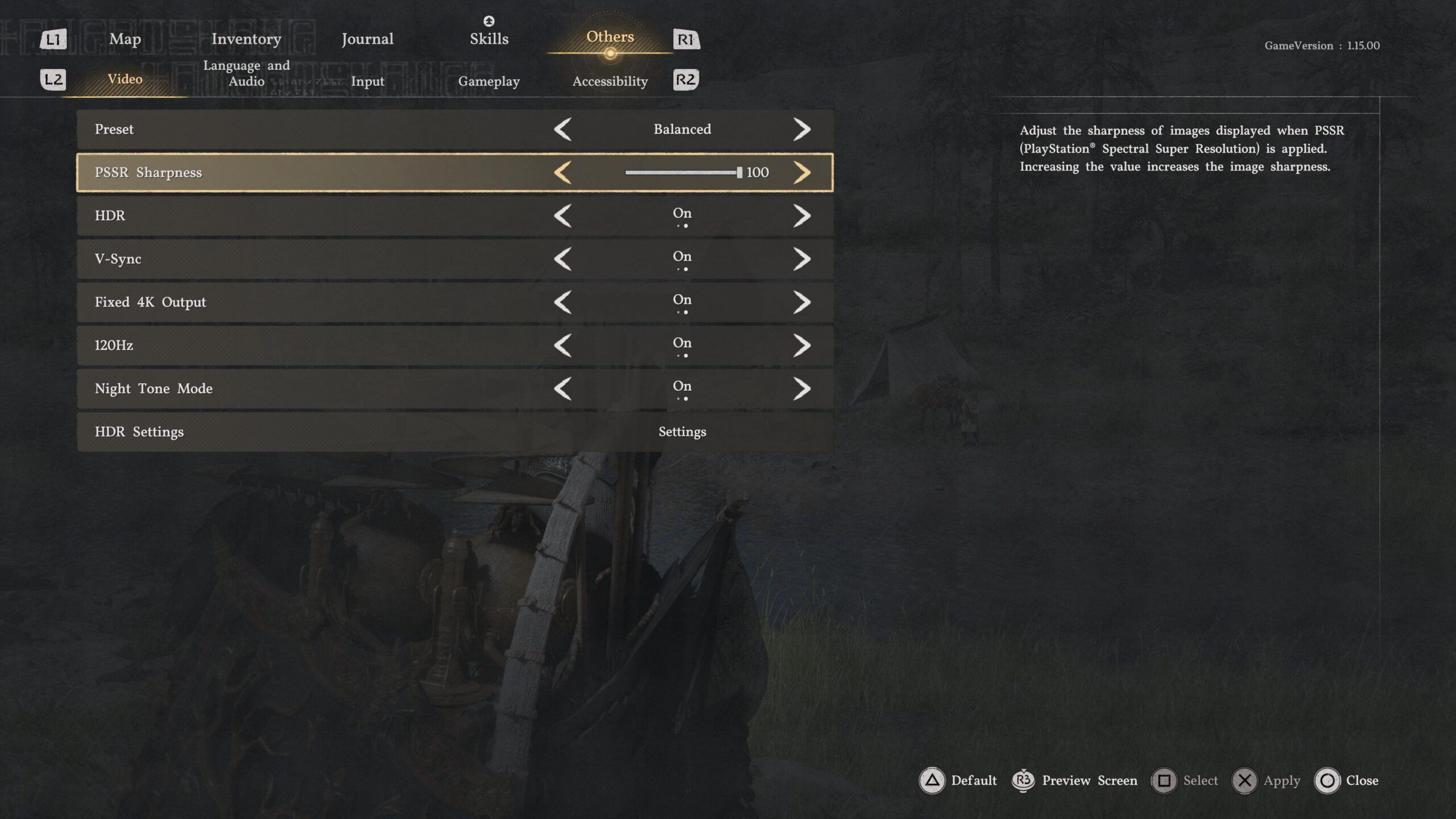
| Setting | Mine |
|---|---|
| Preset | Balanced |
| PSSR Sharpness | 100 |
| HDR | On |
| V-Sync | On |
| Fixed 4K Output | On |
| 120Hz | On |
| Night Tone Mode | On |
Two of those matter more than the rest. V-Sync is on and 120Hz is on together, which is precisely the configuration Pearl Abyss recommended in that March patch note. If you run balanced with V-Sync on and 120Hz off, you are the case they warned about, and you may be locked to 30fps without ever knowing why.
The sharpness slider is the one I would argue about with myself. I have it at 100, which is maximum, and the in-game description says only that raising the value increases image sharpness. There is a report that pushing it costs frame rate, which we have not verified. If you are running balanced and chasing 40fps, that is worth knowing before you copy my number. I like the image at 100. I cannot yet tell you what it costs.
What I cannot tell you
I have never played this on a base PS5, and you should weigh that. Pearl Abyss did not send base PS5 code to critics before launch, which drew accusations of concealing performance problems, and post-launch reports described blurry textures across all three modes, performance mode falling well below 60fps in populated areas, and camera stutter in quality mode. My 193 hours are a Pro owner’s 193 hours. If you are on a base PS5, go and read someone who was.
The one real flaw, which shows up twice
There were missions I could not finish without going to the internet, because the game had not explained what it wanted. That is a real design failure and I am not going to soften it.
Then there was Damiane. She stopped answering. I could not summon her, no message told me why, and I spent a long stretch assuming I had broken something permanent. She was injured, it turns out. The game simply never said so. She reappeared eventually, in her own time, offering no explanation and no apology, and by then I had lost a genuinely unpleasant afternoon to it.
Those look like two complaints but they are one. Crimson Desert is unusually reluctant to tell you things. When that reticence is aimed at exploration it is the best quality the game has, because nothing is spoiled and everything is yours to find. When it is aimed at systems, it is just a game withholding information you need. The difference between the two is whether being lost is the point.
Pearl Abyss has patched comrade behaviour several times, including a 1.02.00 fix for comrades not returning from completed combat missions. Having now read all thirty-two patch notes, I can tell you that none of them addresses injury notification. The game still does not tell you.
Separately, and much more mundanely: the wagons. They are effectively undrivable in third person. Switch to first person and they behave. That is a small thing in a 193-hour game and it irritated me every single time, partly because nothing tells you that either.
Whether the reticence is a dealbreaker depends on what you are. If you play with a walkthrough open on your phone, you will not notice. If you like being genuinely lost and working it out, most of this reads as feature. If you want a game that tells you clearly what is happening, this is the wrong one and you should not buy it on my recommendation.
Who it is for
People who explore. People who like a slow pace and do not experience it as a fault, which I do not. People who want to be able to go back. It is one of the year’s standout releases on those terms, on a Pro, and a poor fit if you want to be led.
Verdict: on the shelf. 193 hours, PS5 Pro, balanced mode, no score, because a number would tell you less than the last six sections did.
Sources
- Patch notes index, first-party archive. All thirty-two patch notes from 1.00.03 to 1.16.01 read and searched for VRR, LFC, tearing and frame pacing, on 26 July 2026 and again on 2 August 2026. Only 1.00.03 mentions any of them. The count is of notes, not versions, because some versions are published separately for PC and console.
- Patch notes 1.00.03, 23 March 2026, revised 25 March. 120Hz separated into an optional setting; V-Sync in balanced mode may lock to 30fps; 120Hz or VRR-with-V-Sync-off recommended.
- Patch notes 1.02.00, 4 April 2026. Upgraded PSSR Sharpen on PS5 Pro, Upgraded PSSR Native AA in quality mode, chapter 6 and 11 quest fixes, comrade return fix.
- Patch notes 1.03.00 (board 81), added the “PSSR Sharpness” option under Settings > Video on PS5 Pro. Cross-confirmed by Push Square’s PS5 reprint.
- Patch notes 1.04.02, fixed unstable screen brightness when PSSR Sharpness was enabled.
- Patch notes 1.08.00, 22 May 2026. No VRR, LFC or console display changes.
- Patch notes 1.13.00, 3 July 2026. Oongka and Damiane can enter the Abyss; PS5 cutscene stutter fix.
- Digital Foundry: Crimson Desert on PS5 Pro, John Linneman, 12 March 2026, near-final code.
- PSSR sharpness performance cost report, unverified by us.
- Pearl Abyss: 5 million copies sold, first-party.
- Pearl Abyss: worldwide launch, 19 March 2026 at 22:00 UTC, which is 20 March at 07:00 in Korea and Japan.
- Base PS5 performance reports and review-code controversy
- Push Square review
- Console settings verified in person, PS5 Pro, 25 July 2026.