
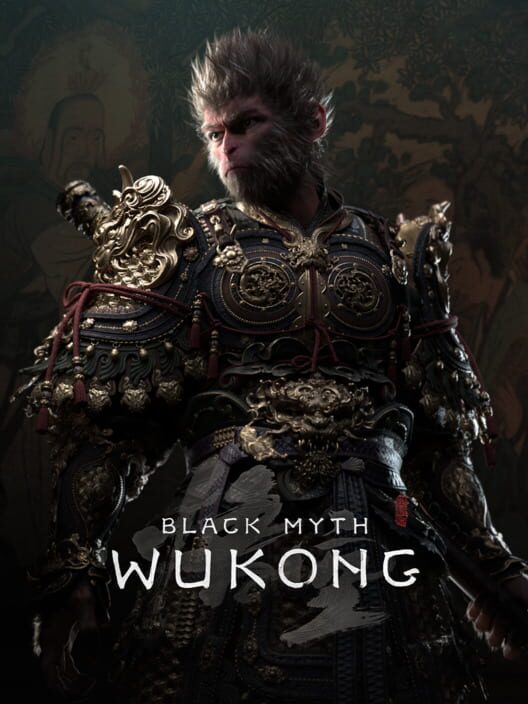
Black Myth: Wukong
- Released
- 20 August 2024Xbox Series X|S version from 20 August 2025
- Platforms
- PS5, PC, Xbox Series X|S
- Developer
- Game Science
- Publisher
- Game Science
Player ratings read 28 September 2026
The short version. On a PS5 Pro, quality and balanced get PSSR upscaling from around 1296p and look considerably sharper than the base console’s FSR2. Performance mode was rebuilt in October 2025 and is now a real option: 60Hz, lower input latency, higher resolution, paid for with reduced lighting quality. If your settings menu says Performance Mode (Legacy), that is the old frame-generation version and you almost certainly want the new one. And when a boss stops you dead, the answer is usually sparks rather than skill. Farm, respec, come back.
The entry that put Crimson Desert on this shelf turned on one question: does the world stay open. Can you go back, can you go anywhere, does the game ever close a door behind you.
Black Myth: Wukong fails that test almost completely. It is still an easy recommendation, and holding both of those thoughts at once is the whole reason this shelf exists.
Game Science released it globally on 20 August 2024, built out of Journey to the West and casting you as the Destined One. For a lot of players it was the first time Chinese mythology carried a game of this budget. That framing does real work. The creature design is drawing on a well most action games have never been near, and it shows in every boss silhouette.
What it feels like
Fast, heavy, and unforgiving in a way that is mostly fair.
The bosses are the game. Not because they have more health than you can chew through, but because most of them arrive with a mechanic you have not seen and expect you to work it out. That is the difference between difficulty and padding, and Game Science lands on the right side of it far more often than not.
Which does not mean it is pleasant. I fought the Tiger Vanguard more times than I am going to admit in print. The thing that eventually got me through was not skill, it was sparks. Farm enough and the wall becomes a step. Knowing that early would have saved me an evening, so consider this the tip: when you are properly stuck, the game usually wants you to go and get stronger rather than get better.
The system I did not expect to love is the respec. You can redistribute skill points at any time, for free, with no penalty. That turns your build from a commitment into a tool. Walking up to a boss and rebuilding around what it does, then rebuilding again for the next one, is a genuinely different way to play an action RPG, and it quietly removes the anxiety that makes people follow a build guide instead of experimenting. There are transformations, spells and weapon techniques enough that the experimenting is worth doing.
The world you cannot enter
Here is where it parts company with everything else on this shelf.
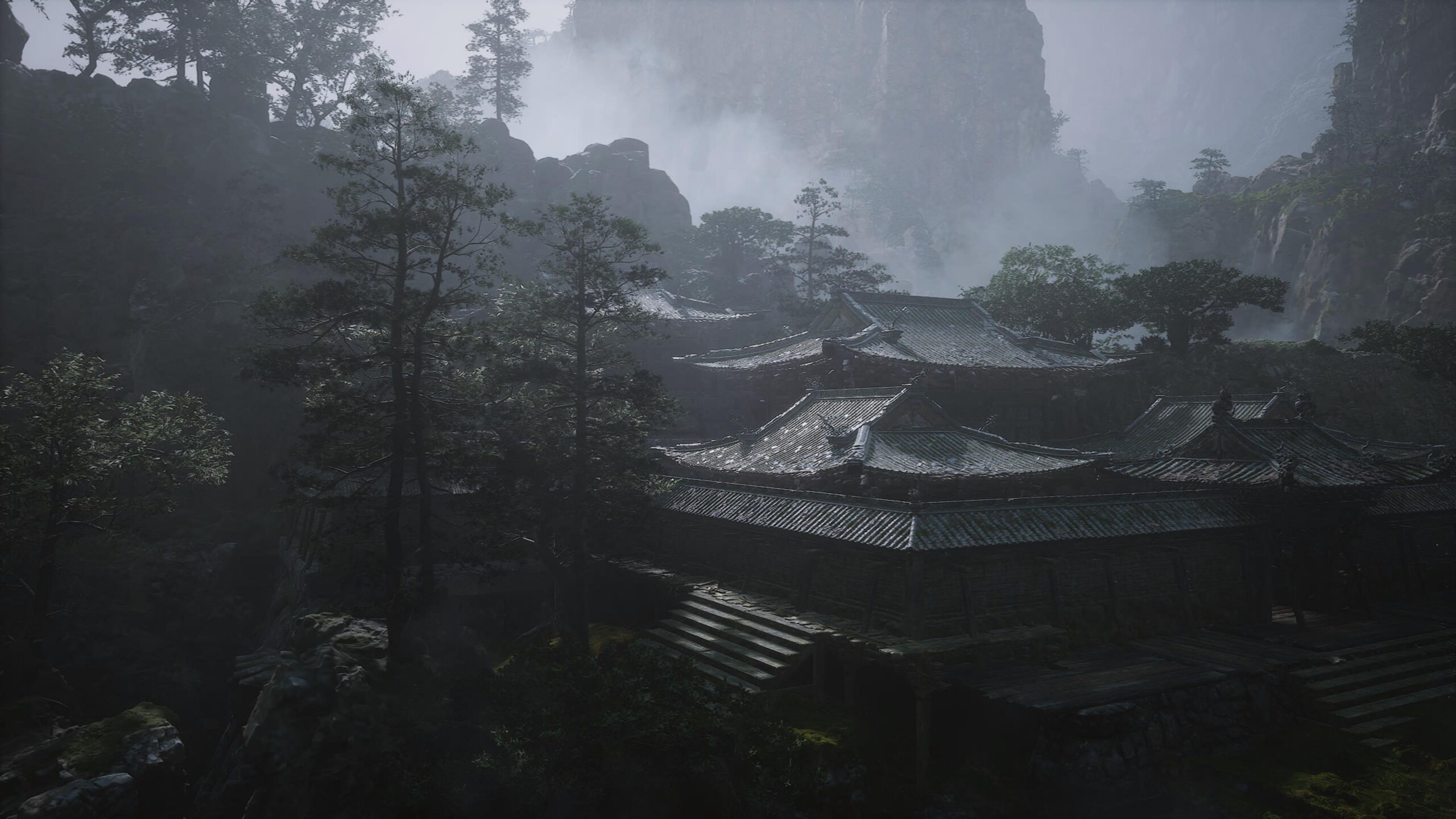
It looks like an open world. The buildings are beautiful and almost none of them open. There are mountains sitting on the horizon that you will never stand on, because they are scenery. Chapter 3 lets you into more of its architecture than the others do, which only makes the rest more noticeable.
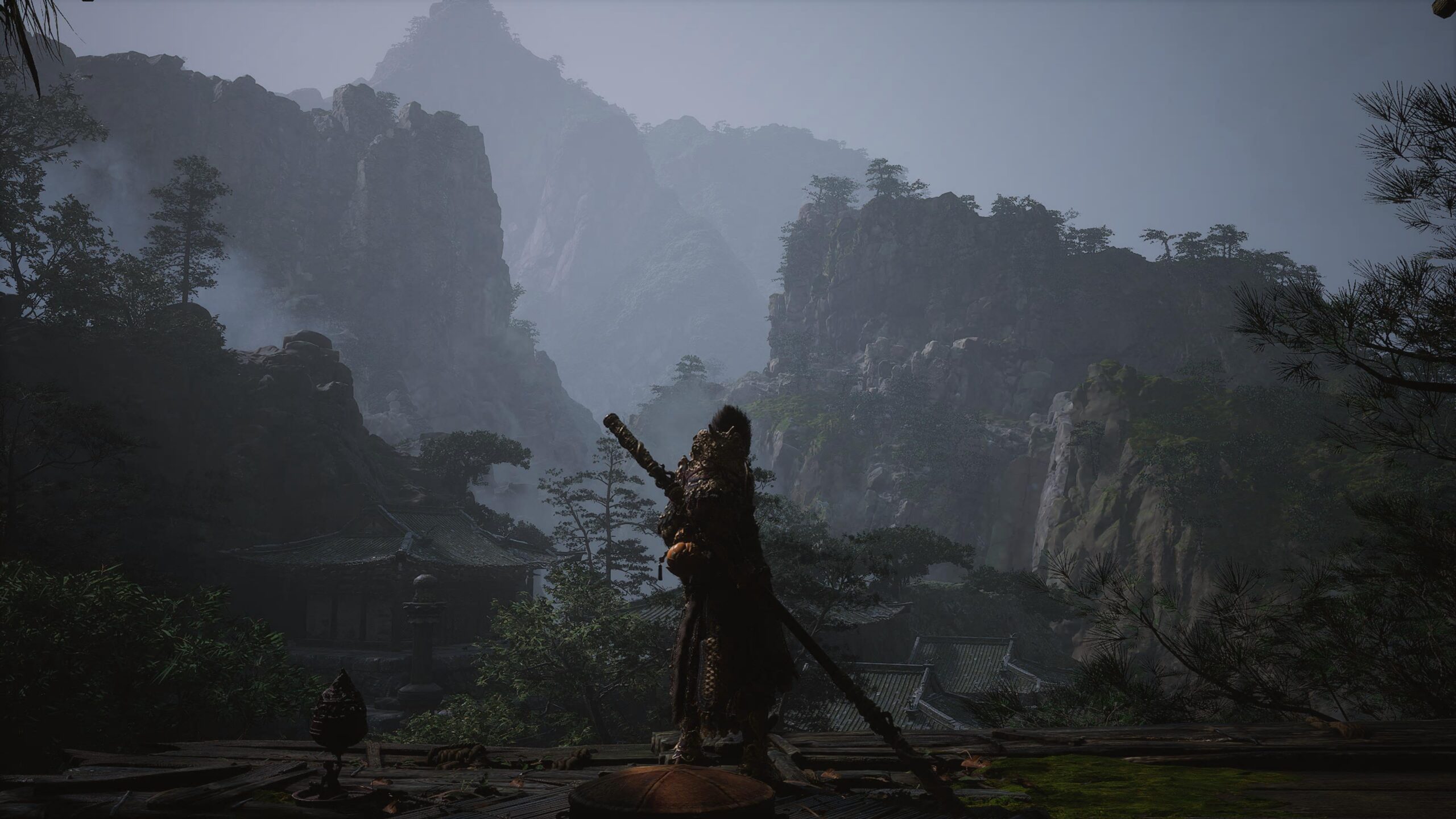
The distance is not really the point though. Look at the screenshot beside this paragraph. The mountains behind are unreachable, which you would expect. The temple roofs at the bottom of the frame are also unreachable, and they are perhaps fifty metres away. And the spot the Destined One is standing on has an invisible wall directly in front of it, so you cannot even walk to the edge of the cliff you are being invited to admire.
That is the whole thing in one image. Black Myth composes gorgeous views of places you cannot go, and then stops you slightly short of the vantage point it built for you.
The contrast that makes this concrete is Red Dead Redemption 2, also on this shelf. Nearly every piece of land you can see in that game, you can walk to. Point at a ridge on the horizon and you can go and stand on it. Black Myth puts a wall between you and a rooftop you could throw a stone at. Neither approach is wrong. But they are answering different questions, and knowing which one you are in the mood for is most of the decision.
The closest comparison is The Last of Us Part II: a corridor dressed convincingly enough that you keep testing the edges, and the edges keep pushing back. It is not open world in the sense Crimson Desert or Cyberpunk are, where the introduction ends and the map is yours.
That is not a defect. It is a design choice, and the game is superb at what it chose. But it is the single most useful thing to know before you buy, because if what you want is somewhere to wander, this is not it. Every hour is pointed at the next fight.
Where 218 hours went
Fair question, given I have just told you the map is small.
The answer is New Game Plus, and it is unusually well judged. You carry your sparks forward, your gear, your levels. A second run is not a reset, it is the same character walking back into the same fights with everything they learned, which means the difficulty curve bends rather than resetting to zero. Combined with the free respec, that makes a replay feel like a different build rather than a repeat.
Then there is the Gauntlet of Legends, the boss rush reached through the Challenge option at a Keeper’s Shrine. It took a chunk of time when it arrived, and it is smarter than a rematch menu. Bosses are grouped into themed sets, each set is only available once you have beaten those bosses in the campaign, and each one pays out named rewards rather than generic scrap: pills, crafting materials like Kun Steel, curios, the odd formula.
The part worth knowing about is the Curses. Before a run you can stack self-imposed restrictions. One disables all your spells. One triples the stamina cost of dodging. One stops your gourd refilling between victories. One puts the whole set on a timer. You are choosing your own difficulty, in specific and legible ways, rather than picking easy or hard off a menu.
The Tiger Vanguard turns up in two separate sets, which after my campaign felt personal.
All of which points at what the corridor complaint misses. Black Myth does give you freedom. It just puts it in the build rather than the map. You cannot go anywhere, but you can be almost anything, you can change your mind about it in front of a boss for free, and in the Gauntlet you can even choose which of your own limbs to tie behind your back. That is a coherent design position, and it is why 218 hours in a linear game is not the contradiction it sounds like.
How it runs on PS5 Pro
The game carries the PS5 Pro Enhanced label, and it earns it, though not evenly.
Digital Foundry’s launch analysis of the base PS5 version, by Oliver Mackenzie and Alex Battaglia in August 2024, was blunt. The game was one of the best-looking things they had seen that year and all three of its modes were badly configured.
Quality ran at roughly 1440p internally, upscaled to 4K with FSR 3, and held together in stills while falling apart in motion. Its frame rate wandered between 31 and 36fps rather than sitting at 30, which suggested the cap was simply broken. Balance ran at a flat 1080p and targeted 45fps inside a 60Hz container, a frame delivery scheme that guarantees judder. Performance used the same 1080p with an aggressive sharpening filter and was the only mode using FSR 3 frame generation, which got it to 60fps most of the time at the cost of artefacts and more input lag than you would feel at 30. There was no 120Hz support, no VRR, no HDR. DF’s read was that these were fixable own goals from a PC-first studio without much PS5 experience.
The Pro patch, which DF covered in December 2024, fixed most of that and left one hole. Quality and balanced modes on Pro use PSSR upscaling from roughly 1296p, and the result is noticeably sharper with fewer motion artefacts than the base console’s FSR2.
Performance mode was the exception, and for nearly a year it was a bad one. On Pro it used FSR3 rather than PSSR, ran at 1080p, and still leaned on frame generation, so the latency trade-off DF criticised at launch survived on the more expensive console.
Then Game Science rebuilt it. Patch 1.0.20.21756, on 13 October 2025, adjusted performance mode back to 60Hz, which their own notes describe as reducing input latency and reaching a higher resolution than before, with the lighting quality level lowered to pay for it. The old version was kept and renamed Performance Mode (Legacy). The same patch fixed screen ghosting and edge flickering on PS5, improved loading speed, and sharpened certain textures. A follow-up in January 2026 cleaned up screen tearing in the Journeyer’s Chart interface in performance mode.
So the advice has changed, and most coverage has not caught up. Performance mode is now a genuine choice rather than a latency tax. You are trading lighting quality for responsiveness and resolution, which is a real trade rather than a bad deal. Quality remains the prettiest. And if your menu still reads Legacy, you are running the frame-generation version by default and should switch unless you specifically prefer the lighting.
Base PS5 owners got a real fix too, with a catch. Quality mode is now a locked 30fps with proper pacing, but it dropped from 1440p to 1080p to get there. Balanced targets 40fps on a 120Hz display and 45 on a 60Hz one. A sharpening slider arrived at the same time.
The DLC that became a different game
If you are buying now, this matters more than it would have a year ago.
Game Science had signalled ideas for expanding Wukong and the rumour mill ran with it for months. On 22 August 2025 they said no. There would be no traditional DLC. CEO Feng Ji framed it as preferring to make “a new Black Myth game first”, with a new hero, new gameplay, new technology and new story, and said Sun Wukong’s legend would return in due course once properly prepared.
That new project is Black Myth: Zhong Kui, positioned as the franchise’s next step rather than an expansion.
I was disappointed, and I think the reasoning is sound. A studio that would rather rebuild than extend is a studio worth watching. But it does mean the game you buy today is the whole game, and it is not going to grow. Price your purchase accordingly.
Who it is for
People who want to be tested. People who like a boss that changes the question rather than raising the number. Anyone curious about Chinese mythology in a form that treats it seriously.
Not for people who want to wander. Not for people who bounce off repeated failure, though the sparks route means the wall is always climbable if you are willing to go away and come back. And if you are chasing 60fps, check which performance mode you are actually in before you judge the latency, because the answer changed in October.
For what it is worth, I played the whole thing in quality mode. I almost always do. If a game has put this much into how it looks, spending frames to see it properly is the trade I want, and Wukong is the strongest argument for that position I have played in years.
Verdict: on the shelf. 218 hours, PS5 Pro, quality mode, no score. I did not enjoy every boss, and I would still recommend it to almost anyone. Red Dead Redemption 2, where you can walk to everything you can see
Sources
- Digital Foundry: Black Myth: Wukong on PS5 is fetching, flawed but fixable, Oliver Mackenzie and Alex Battaglia, 21 August 2024. Launch analysis of the base PS5 version: quality ~1440p internal to 4K via FSR 3 with a frame rate wandering 31-36fps; balance 1080p targeting 45fps in a 60Hz container; performance 1080p with heavy sharpening and FSR 3 frame generation; no 120Hz, VRR or HDR support at launch.
- Digital Foundry: PS5 Pro support added, is base PS5 improved too?, 26 December 2024. PSSR from ~1296p in quality and balanced on Pro; performance mode retains FSR3 at 1080p with frame generation; base PS5 quality mode locked 30fps but dropped 1440p to 1080p; balanced 40fps on 120Hz, 45fps on 60Hz; sharpening slider added.
- Game Science: no Wukong DLC, Black Myth: Zhong Kui instead, 22 August 2025. Feng Ji and Yang Qi statements.
- Game Science official site, first-party. Global release 20 August 2024.
- Patch notes 1.0.20.21756 (PS5, PC), 13 October 2025, first-party. Performance Mode adjusted back to 60Hz with reduced input latency and higher resolution, lighting quality lowered to compensate; old mode retained as “Performance Mode (Legacy)”. Also fixed PS5 screen ghosting and edge flickering, improved loading speed and texture clarity.
- Patch notes 1.0.21.23831, 12 January 2026, first-party. PS5 version 1.0.21.23672. Fixed screen tearing in the Journeyer’s Chart UI in Performance Mode. No further PS5 Pro mode changes, making October 2025 the current state.
- Black Myth: Zhong Kui background
- Gauntlet of Legends, community wiki, CC-BY-SA. Used for mode name, access point, gating and the Curse list. Corroborated by play.
- PS5 Pro patch PSSR implementation
- Play impressions and hours: PS5 Pro, 218 hours logged, quality mode.