
The studio making the biggest game in history has a labour question to answer first, and this week it got harder to duck. The Rockstar Game Workers Union says it now has more members than ever, enough to pursue mandatory recognition, and its first face-to-face meeting with management has already happened. GTA 6 launches in about four months.
Where things stand
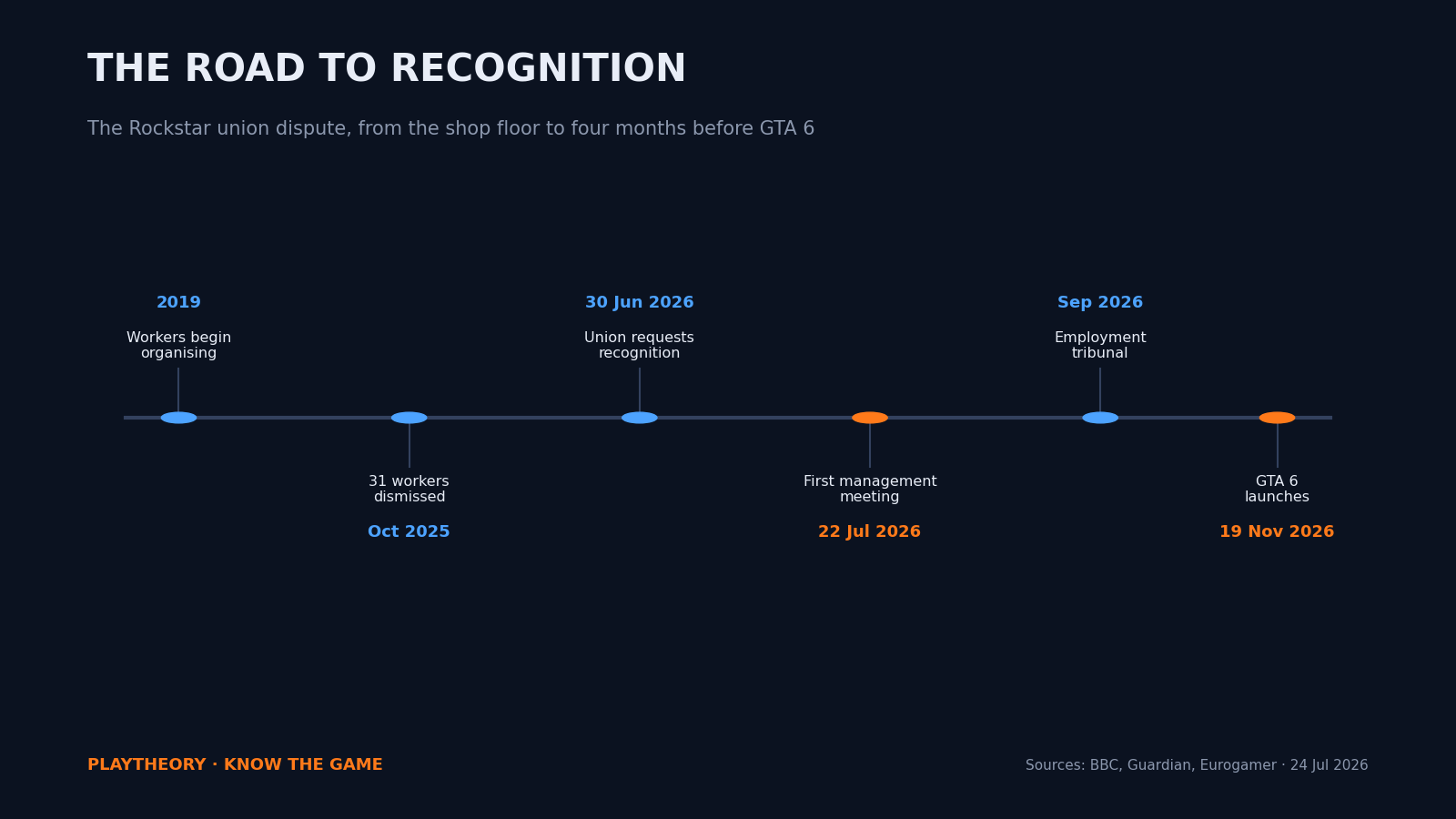
On June 30 the Independent Workers’ Union of Great Britain formally asked Rockstar to voluntarily recognise its games union, to open channels on crunch, pay transparency and flexible working. Rockstar confirmed it received the request and would “arrange to meet.”
Source: BBC
That first meeting took place on July 22. The union secured “a roadmap for a speedy negotiation process” and called it “a step in the right direction.” Rockstar has asked to negotiate before granting recognition rather than granting it outright.
Source: GamesRadar, GodisaGeek
The union says membership is at a record high, which opens the door to statutory recognition. If voluntary talks stall, it can apply to the UK’s Central Arbitration Committee, which can compel recognition once membership passes a legal threshold.
Source: People Make Games, via Eurogamer
Rockstar dismissed 31 UK workers last October. The union says they were sacked illegally for organising; Rockstar says it was gross misconduct for sharing confidential information in a public Discord group. That case goes to an employment tribunal in September.
GTA 6 launches November 19, 2026, roughly four months out. Nothing reported links the union drive to the game’s schedule.
Source: Rockstar Games
Recognition would shape how GTA 6’s post-launch content and Rockstar’s next decade of games get staffed and scheduled, not the November 19 date. This is our read, not a reported claim.
Source: PlayTheory analysis
Why the number is the news
A union asking to be recognised is ordinary. This one being big enough to compel it is not. Under UK law, once a union proves enough membership in a workplace, it can trigger a process through the Central Arbitration Committee that ends in mandatory recognition. That is why the “more members than ever” line matters more than any single quote: it moves the decision from something Rockstar can decline to something it may not be able to.
The union frames the July 22 meeting as progress rather than victory. Recognition was not granted; a negotiating timetable was. Alex Marshall, president of the parent IWGB, has said that if Rockstar does not engage in good faith, the union is “very happy to use different mechanisms to ensure recognition.” The next practical step is duller and just as important: defining the “bargaining unit,” meaning exactly which workers the union would represent.
What both sides are actually saying
The union’s asks are specific: an end to mandatory crunch, paid overtime, pay transparency, flexible and remote work, no-layoff commitments, and protection against jobs being replaced by AI. One developer told GamesRadar that crunch is embedded deeply enough that contracts include, as standard, an opt-out of the UK’s Working Time Regulations. The workers organising this trace back to 2019, and some of the loudest voices are people the firings touched. Jack Hoxby, one of the ex-staff heading to tribunal, called the fight “David and Goliath” and said the pre-order hype was “bittersweet” for someone who worked on the game but still backs his former colleagues.
Rockstar’s position deserves equal weight, because it is not a shrug. The company “strenuously” denies the union-busting claim and says the 31 were dismissed for sharing confidential material in a public Discord, not for organising. Its statement points to “world-class work environments” and employee retention it says is “well above the industry standard,” and it confirms it will meet the union. There is outside support for part of that picture: Bloomberg’s Jason Schreier has reported that Rockstar worked to avoid the kind of extreme overtime that defined the Red Dead Redemption 2 era. Both things can be true at once: a company that improved conditions, and workers who want those improvements written down and enforceable rather than granted at management’s discretion.
What it means for GTA 6, and the games after it
No reported link ties any of this to the release date, and we are not going to invent one. November 19 stands. The nearer effect is on the rollout that follows launch. A game’s hardest crunch rarely ends on release day; it moves into the live-service tail, the patches, the GTA Online content and the DLC that a title this size will run for years. Enforceable terms on overtime and staffing would show up there first, in how that tail gets built, long before they showed up in a release date.
The longer effect is on everything after GTA 6. Rockstar makes games on seven-and-eight-year cycles, historically with punishing end-of-cycle crunch. A recognised union with written limits on mandatory overtime, layoffs and AI replacement would change the economics and the timeline of the next Rockstar game far more than it changes this one. And the precedent runs past Rockstar entirely: only one UK studio, ZA/UM of Disco Elysium, currently has a recognised union. If the biggest studio in the country recognises its workers, it resets what the whole UK industry treats as normal.
The PlayTheory take: the workers rebuilt after a round of firings that could have ended the effort, and rebuilt to a size that changes the maths. Rockstar, for its part, has read the same law and agreed to talk rather than stonewall. The question is no longer whether the union gets its meeting, because it did; it is whether a company shipping the biggest game ever decides a written deal with its workers is cheaper than a public fight through launch and into the next game. On the numbers, it is.
Related: our GTA 6 hub · the SEC filing that reaffirmed November 19