
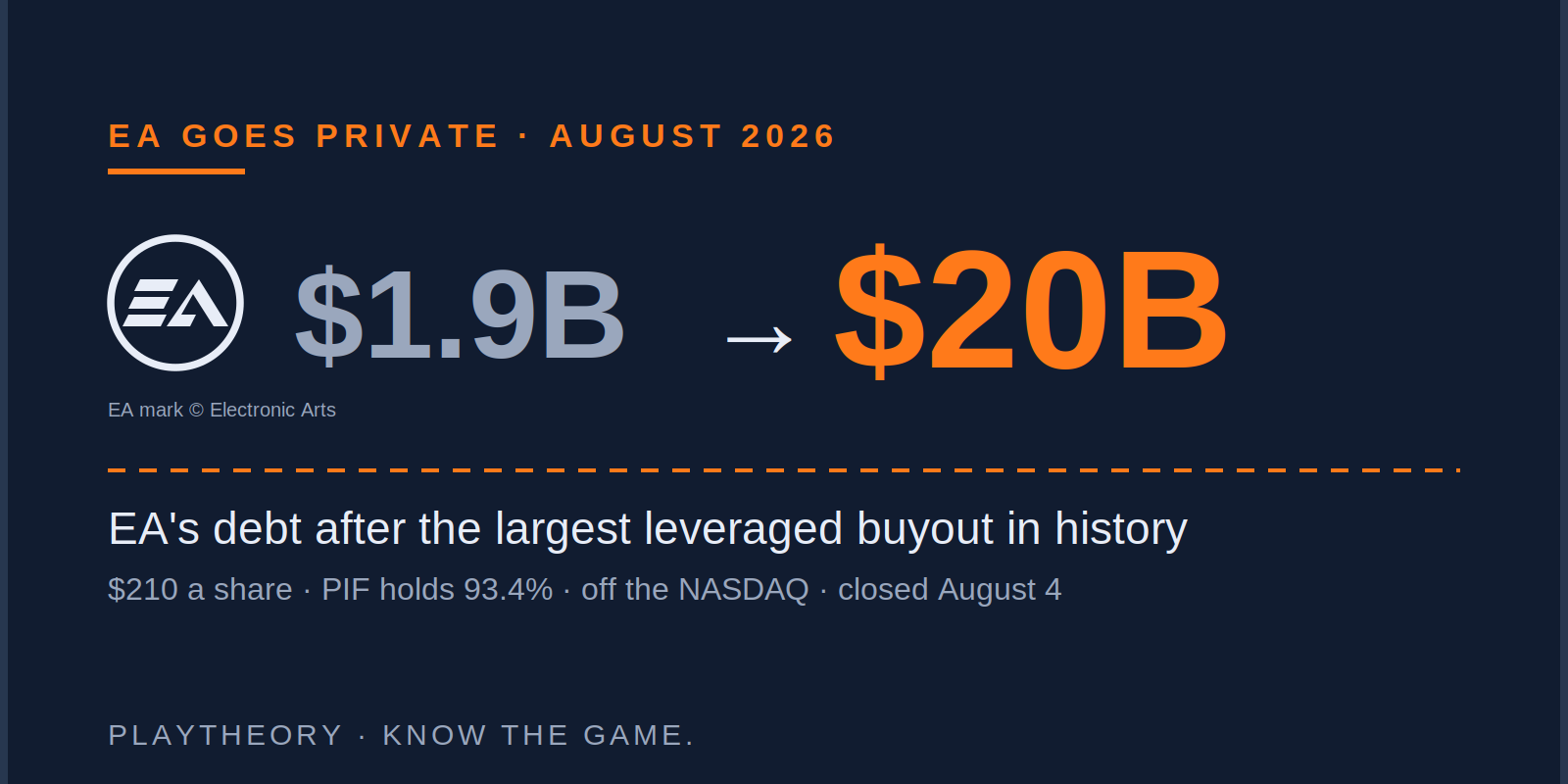
EA’s acquisition by a consortium led by Saudi Arabia’s Public Investment Fund closed on August 4, 2026. PIF holds about 93.4%, Silver Lake 5.5%, and Affinity Partners 1.1%. Shareholders got $210 in cash per share, a 24.8% premium on the pre-leak price, and the stock is off the NASDAQ. It’s the largest leveraged buyout in history.
The $55 billion is done and paid. The figure that will actually reach your controller is the roughly $20 billion of debt EA now carries, and that story is only starting.
From $1.9 billion to $20 billion
Before the deal, EA carried about $1.9 billion in total debt, modest for a company doing $7.5 billion in annual revenue. The buyout changes that completely. We broke down how the buyout math works when the deal was announced; now the numbers are real. Because this is a leveraged buyout, a large slice of the purchase price was borrowed and then placed on EA’s own books. EA’s debt jumps to roughly $20 billion, about ten times what it was.
Some of that borrowing is expensive. A JPMorgan-led bond sale in March priced $4.75 billion of secured notes at 7.25% and $2.5 billion of unsecured notes at 8.75%. Servicing that costs real money every year, and it has to come from somewhere.
What the acquisition means for EA’s games
Nothing is announced. EA and its new owners have said nothing specific about studios, franchises, or staffing, and Andrew Wilson stays on as CEO. What follows is analysis, not reporting.
A private company with heavy debt needs reliable cash flow, and EA’s most reliable cash flows are EA SPORTS FC, Madden, and Apex Legends. The likeliest near-term pattern is doubling down on those live services and their monetisation, because that’s what pays the interest. The open question is what happens to everything that doesn’t print money on a schedule: single-player projects, and studios like BioWare and Maxis whose futures were already the subject of speculation.
There’s a second shift that’s easy to miss. As a private company, EA no longer files quarterly earnings. The disclosures that let players, press, and analysts see what’s working and what’s being cut just went dark.
What it means for gamers
In the short term, probably nothing visible. Your games work, your progress carries over, EA FC 27 ships. Over the next couple of years, watch three things: monetisation intensity in the big live services, the fate of announced single-player titles, and whether PIF’s wider portfolio (it also holds a minority stake in Nintendo and owns ESL FACEIT) starts pulling EA deeper into esports.
And the timing matters. EA’s first private-era year runs straight into GTA VI’s November 19, 2026 launch, and it lands just as Take-Two, flush with cash, has told shareholders it’s shopping for acquisitions of its own. One giant just went private under a debt load; the other is about to have more money than it knows what to do with. That’s the consolidation story of 2026, and we’re covering both ends of it.
We’ll track what EA’s new owners actually do, not just what they say.